The Communists Won the Cold War Using Your Tax Dollars
23 August 2026
Africa’s problem is not a lack of money. It takes vast sums of money to be this dysfunctional.
|
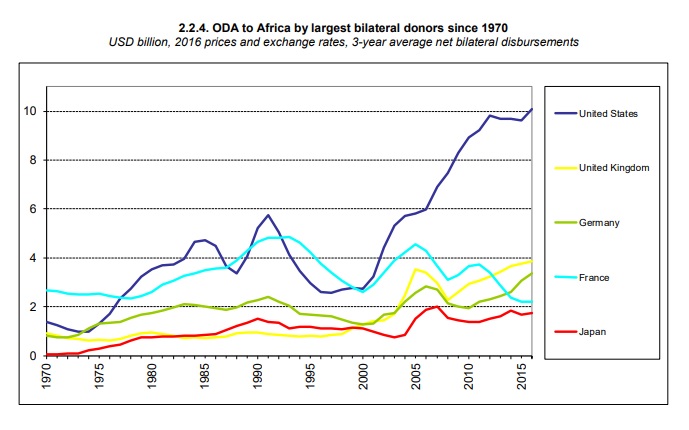
The United States gives far more in aid than other country, but that just proves how guilty it is.
|
| Data sources: IPC, WFP, FEWS NET, USAID, FAO, Center for Systemic Peace, OCHA, Cadre Harmonisé |
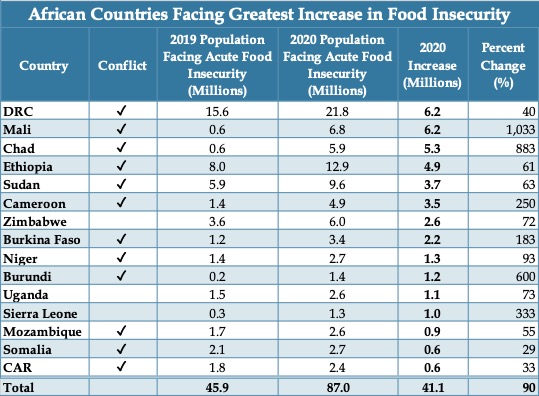
Note in the above chart the rising numbers of millions of hungry people in Zimbabwe despite it being one of the only countries on the list not in conflict during the years the chart covers. The ZANU-PF government that has ruled Zimbabwe since 1980 was not set up to provide for the general welfare of its people, but it is phenomenally good at staying in power.
And why should it be otherwise? How could it be otherwise, when the party’s very genesis rests on the twin pillars of foreign aid and violent plunder? As described by Duncan Clarke in his book The Last Rhodesians:
Even camps and lands made available to Zanla in Moçambique, for Zipra in Zambia, were allocated, not bought by them. Zanu and Zapu formed no companies to generate net funds for their war effort. They would learn no corporate skills to own and manage institutions and state entities afterwards. Almost all their funds found were unearned and untaxed. No virtuous economic track record followed from their endeavours. Refugees from which both armies drew fighters for training and used as age advanced among youth drawn into camps were heavily funded by world agencies abroad. Neither armed entity established self-sufficient rural communes even as limited food crops were grown in or around camps.
Apart from levies and recruits taken in kind from villages and schools, sometimes press ganged under duress, or evacuated from missions, liberation militia drew no serious monies from Rhodesia’s economy. In local food supply, most received in TTLs was gifted in kraals, taken from peasants, or stolen from rural stores...
John Robertson, speaking on Trevor Ncube’s youtube channel in 2021, described ZANU-PF’s approach from its earliest days in power:
There’s a huge contrast between the past and the present and of course that’s not a very popular political subject because people keep on claiming accusations being made when I make these comparisons. But I think the big difference is that in the past the government was very much on the side of business and I think the government of the recent decades has been very much to exploit business. And I think it started in 1980 with the belief that the country could get enormous amounts of aid and therefore did not need the income from business activities as much as the previous Rhodesian government had needed it. So the Rhodesian government was very supportive of everything that was creating wealth and the new government after independence in Zimbabwe decided that the wealth would come in the form of aid and we could push the business sector around. The business sector would become the servant of the government. And I think that ever since we’ve done that, we have discouraged and demotivated so many of the business people who could have done so much more if they’d been inspired by political policies that were supportive of them.
When leaders in commerce and industry pointed out to the government that they were killing the goose that lays the golden eggs, their reply was simple and to the point: ‘We are getting along very well without your golden eggs!’
The principal economic problem resulted from the government’s inability to curb its reckless spending spree. The civil service continued to expand, the security forces were thriving and government ministers lived in opulence. They asked: ‘Why are people concerned; after all, the government provides the money?’
You have a whole young generation who do not understand what just plain honesty might be. Because they feel if they can get away with something, that’s honest enough for them. And meanwhile, it is at somebody else’s expense. And this is really the issue, if anything is at the expense of somebody else who can’t defend themselves against these pressures, you’ve created a very uncomfortable situation in which many, many people never build up the stamina to cope with life in normal ways. And so we have thousands, millions, of very poor people in this country today. And this is a tragedy, because this should be a relatively wealthy country. This was one of the most developed countries in the whole of Africa until 1980. And now we are right at the bottom of the list.
Everybody knows the government is corrupt. They know that everybody knows that they’re corrupt. But nobody can do anything about it. So they just go on being corrupt... Anyone who is a South African knows exactly what I’m talking about. Doesn’t matter, even the people who are pro-ANC, they know that it’s a corrupt mess of a government, it’s a corrupt useless government... On top of the fact that there’s no power, there’s close to 50% unemployment rate... Can you imagine half of your population being unemployed? You know what that leads to. When half of the people are lying around out there, just ambling around during the day, trying to find a way to survive, it just leads to crime. ‘Cuz there’s no other option. What are you gonna do? If you want to have clothing, if you want to have food, you want to be able to buy something, how do you do it? You need money. You’re not going to get money by chewing the grass on the side of the road, are you? You have to go and rob people, steal, rape, kill, murder, maim, all that kind of stuff. That’s what happens in South Africa. It’s incredibly dangerous to live there. It’s incredibly difficult to make a living there. Because not only do you have to put up with the crime and the constant, for lack of a better word, pestering by the government to try and eke every cent they can out of you because it’s a corrupt government that has no money and keeps trying to find ways to get people to pay them more money. You have to deal with that. But you also have to deal with the basic infrastructure going out. You have power going out, traffic lights not working, all that kind of stuff. It’s just a non-starter. Anyone who’s smart or had the means, has left already.